
CPR Compression Rate & Depth by Age: How Fast and How Deep to Push
16 hours ago
7 min read
Key Highlights
The CPR compression rate is 100 to 120 compressions per minute for adults, children, and infants.
Compression depth depends on age: at least 2 inches (5 cm) but no more than 2.4 inches (6 cm) for adults, about 2 inches (5 cm) for children, and about 1.5 inches (4 cm) for infants. For children and infants, that is about one-third the depth of the chest.
Let the chest fully recoil after every compression, and keep pauses as short as possible.
With two rescuers, switch compressors about every 2 minutes so quality does not drop as people tire.
The numbers in this guide follow the 2025 American Heart Association (AHA) guidelines. Your instructor’s course materials are always the final word for your class.
30:2 Rescue LLC teaches compression rate, depth, and technique hands-on in Pasadena, so the right feel becomes automatic.
Introduction
Most people who hesitate to start CPR are afraid of doing it wrong. The good news is that the two things that matter most are easy to describe: push fast enough and push deep enough, then let the chest come back up. Everything else builds on those basics.
This guide is about how you compress. It covers the right rate, the right depth for adults, children and infants, hand placement, recoil, fatigue and the mistakes we see most often in class. If you want to know how many compressions to give before breaths, read our companion guide to the CPR compression-to-breath ratio.
This article is educational and does not replace hands-on training. In an emergency, call 911 first.
Quick Answer: How Fast and How Deep Should CPR Compressions Be?
Push at 100 to 120 compressions per minute. For an adult, press at least 2 inches (5 cm) deep, but not more than 2.4 inches (6 cm). For children and infants, press about one-third the depth of the chest. Allow the chest to fully rise between compressions, and keep interruptions short.
Person | Rate | Approximate depth | Hands |
Adult (puberty and older) | 100–120/min | At least 2 in (5 cm), not more than 2.4 in (6 cm) | Two hands, heel of one hand on the lower half of the breastbone with the other on top |
Child (1 year to puberty) | 100–120/min | About one-third of chest depth, around 2 in (5 cm) | One or two hands, depending on the child’s size |
Infant (under 1 year) | 100–120/min | About one-third of chest depth, around 1.5 in (4 cm) | Two thumbs encircling the chest, or the heel of one hand |
The AHA publishes these targets in its guidance on what CPR is and how to perform it.
Compression Rate: 100 to 120 Per Minute
A rate of 100 to 120 compressions per minute works out to roughly two compressions per second. This range balances blood flow with control. Compress too slowly and less blood reaches the brain and heart. Compress too quickly and the compressions tend to become shallow, which defeats the purpose.
Tips for finding the right pace:
Count out loud. A steady count, “one and two and three…,” helps you keep tempo and tells the rescuer next to you where you are in the cycle.
Use a familiar beat. Many people use a song with a tempo in the 100 to 120 range, such as “Stayin’ Alive,” as a mental metronome.
Practice with feedback. Mannequins with feedback lights or sounds show you instantly whether you are in the target zone. In class, this is where most students find out their natural pace is too slow or too fast.
Compression Depth by Age
Depth is one of the strongest drivers of good CPR, and shallow compressions are the most common mistake, especially as a rescuer tires.
Adults: At Least 2 Inches, Not More Than 2.4 Inches
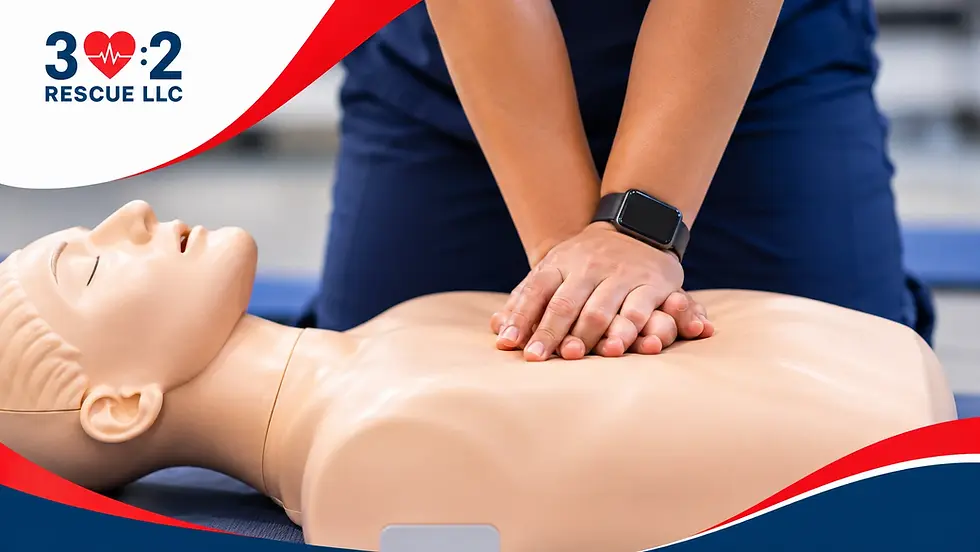
Place the heel of one hand on the lower half of the breastbone, put the other hand on top, and push straight down at least 2 inches (5 cm). Avoid going deeper than 2.4 inches (6 cm). A firm, flat surface under the person helps. If they are on a bed or sofa, move them to the floor if you can do it safely without losing time.
Children: About 2 Inches
For a child, press about one-third the depth of the chest, which is around 2 inches (5 cm). Use one hand or two hands, depending on the child’s size and what lets you reach the target depth with control.
Infants: About 1.5 Inches
For an infant, press about one-third the depth of the chest, around 1.5 inches (4 cm). The 2025 AHA and American Academy of Pediatrics guidelines no longer teach the two-finger technique. Use the two-thumb encircling hands technique, which is preferred when two rescuers are present, or the heel of one hand. Our guide to infant vs. adult CPR for parents explains the differences step by step.

Full Chest Recoil: The Overlooked Half of Every Compression
Every compression has two parts: the push down and the release. Recoil means letting the chest return fully to its normal position before the next push. That release lets the heart refill with blood, so the next compression has something to move.
The most common recoil problem is leaning, which means resting some of your body weight on the chest between compressions. To avoid it:
Lift your weight just enough to let the chest rise, while keeping your hands in place.
Keep your shoulders directly above your hands.
Watch the chest. If it is not coming back up, you are leaning.
Body Position and Hand Placement Checklist
Good technique makes depth easier and protects you from tiring too quickly.
Kneel beside the person’s chest.
Place the heel of one hand on the lower half of the breastbone, with the other hand on top (adults).
Lock your elbows and keep your arms straight.
Position your shoulders directly above your hands.
Push straight down, using your upper body weight rather than your arm muscles.
Keep your fingers off the ribs.
Avoid Fatigue: Switch Every Two Minutes
Compression quality drops faster than most people expect. With two or more trained rescuers, rotate the compressor about every 2 minutes (roughly five cycles of 30:2), or sooner if the compressor is getting tired. Plan the swap so it takes only a few seconds and so the rescuer arriving takes over the exact hand position. A coordinated swap is a skill we practice in every class.
If you are alone, keep going until an AED arrives, EMS takes over or the person starts to move or breathe normally. When an AED arrives, our guide on how to use an AED walks you through what to do.
What If You Feel or Hear a Rib Crack?
Good compressions can sometimes break ribs, particularly in adults. It is a known risk of effective CPR, and it is not a reason to stop. Check that your hands are in the correct position on the lower half of the breastbone, then continue. A person in cardiac arrest cannot survive without circulation, and a bruised or broken rib can heal.
6 Common Compression Mistakes
Too shallow. This is the most frequent problem. Push to the target depth for the person’s age.
Too slow or too fast. Stay within 100 to 120 compressions per minute.
Leaning on the chest. Allow full recoil.
Long pauses. Keep interruptions as short as possible, including for breaths and AED analysis.
Wrong hand position. Too low and you risk the abdomen. Too high and you may lose effectiveness. Target the lower half of the breastbone.
Bent elbows. Bent arms tire you out and reduce depth. Lock your elbows.
See more examples in our guide to common CPR mistakes and how to avoid them.
Hands-Only CPR: Same Rate and Depth, No Breaths
If you have not been trained in CPR and you see an adult suddenly collapse, call 911 and begin hands-only CPR. The rate and depth are the same: push hard and fast in the center of the chest at 100 to 120 compressions per minute. If you are trained and willing, compressions with breaths is the standard, especially for children and infants. To compare the two approaches, read hands-only CPR vs. traditional CPR.
Practice Makes It Automatic: Learn It Hands-On in Pasadena
Reading the numbers is one thing. Feeling what 2 inches of depth and 100 to 120 compressions per minute actually feels like is another. At 30:2 Rescue LLC, you practice adult, child and infant compressions on professional mannequins and AED trainers, with instructors who have real emergency response backgrounds. We are an authorized training center for both the American Heart Association and the American Red Cross, and your digital certification is delivered within 10 minutes of completing the course.
We offer evening and weekend sessions, mobile training at your workplace on request, and group discounts for groups of six or more. Explore all courses on our CPR and BLS classes in Pasadena page.
If you are… | Consider this class |
A parent, teacher, coach or office team member | |
A childcare provider needing pediatric training | Pediatric First Aid/CPR/AED (in person) |
A nurse, EMT, dental or other healthcare professional | |
A healthcare provider with a current card |
Wondering how CPR breaths fit in with compressions? Read our guide to rescue breaths with a face shield, pocket mask or bag-mask.

Frequently Asked Questions
How deep should CPR compressions be for an adult?
At least 2 inches (5 cm), but not more than 2.4 inches (6 cm). Press straight down on the lower half of the breastbone with both hands.
How fast should chest compressions be?
100 to 120 compressions per minute, which is about two per second. The rate is the same for adults, children and infants.
Is the compression depth different for children and infants?
Yes. For children, press about one-third the depth of the chest, around 2 inches (5 cm). For infants, press about one-third the depth of the chest, around 1.5 inches (4 cm).
Do I need to count compressions?
Counting helps, especially if you are giving breaths, because you need to know when you reach 30. Counting out loud also helps you stay at the right pace.
How often should rescuers switch compressions?
About every 2 minutes, or sooner if the compressor is tiring. Swap quickly so the pause is short.
Is it a problem if I break a rib during CPR?
It can happen, particularly in adults, and it is not a reason to stop. Check your hand position and keep going.
Are compression rate and depth the same in AHA and Red Cross classes?
The core targets covered here are taught the same way in the courses we offer. Some terminology and skills sheets differ slightly between organizations, so your instructor will cover the exact version for your course.
Can I learn CPR entirely online?
No. CPR is a hands-on skill, so our certification courses include in-person practice. Blended courses combine an online portion with an in-person skills session, as explained on our blended course requirement page.
Ready to Practice?
The best time to learn the right rate and depth is before you ever need them. Book a class with 30:2 Rescue LLC, the Pasadena training center that helps you learn the skills, practice them with feedback and earn a certification employers accept. Visit our Pasadena CPR classes page to choose a class, or call us at 213.293.7408.
This article is for educational purposes and is not a substitute for hands-on training. In an emergency, call 911.


Comments