
CPR Compression-to-Breath Ratio: 30:2 vs 15:2 for Adults, Children & Infants
Nov 8
8 min read
Updated: 15 hours ago

Key Highlights
The CPR compression-to-breath ratio is 30 chest compressions to 2 rescue breaths (30:2) for adults, whether one or two rescuers are helping.
For children and infants, a single rescuer uses 30:2. When two rescuers are present, the ratio changes to 15:2.
The compression rate is 100 to 120 per minute at every age. Compression depth changes with the size of the person.
Untrained bystanders helping an adult can use hands-only CPR. Trained rescuers should give compressions and breaths.
The ratios in this guide follow the 2025 American Heart Association (AHA) and American Red Cross guidelines. Your instructor’s course materials are always the final word for your class.
30:2 Rescue LLC teaches these ratios hands-on in Pasadena with American Heart Association and American Red Cross courses.
Introduction
When someone collapses and is not breathing normally, a trained rescuer needs to know two things right away: how many compressions, and how many breaths? The answer depends on the age of the person and on how many rescuers are present.
If you found this page by searching “30:2,” this is not a math problem. It is the rhythm of CPR: 30 chest compressions followed by 2 rescue breaths. It is also the idea behind our name, and it is the first thing we teach in every class at 30:2 Rescue LLC in Pasadena, CA.
This guide explains the CPR ratio for adults, children and infants, why the ratio changes when a second rescuer joins, and the mistakes we see most often in class. It is educational only and does not replace hands-on training. In an emergency, call 911 first.
What Does the 30:2 CPR Ratio Mean?
One CPR cycle is 30 compressions followed by 2 breaths. Compressions move blood to the brain and heart. Breaths add oxygen. Repeating the cycle keeps oxygen-carrying blood moving until an AED is ready, emergency medical services (EMS) take over, or the person starts breathing normally.
A few basics apply to every cycle:
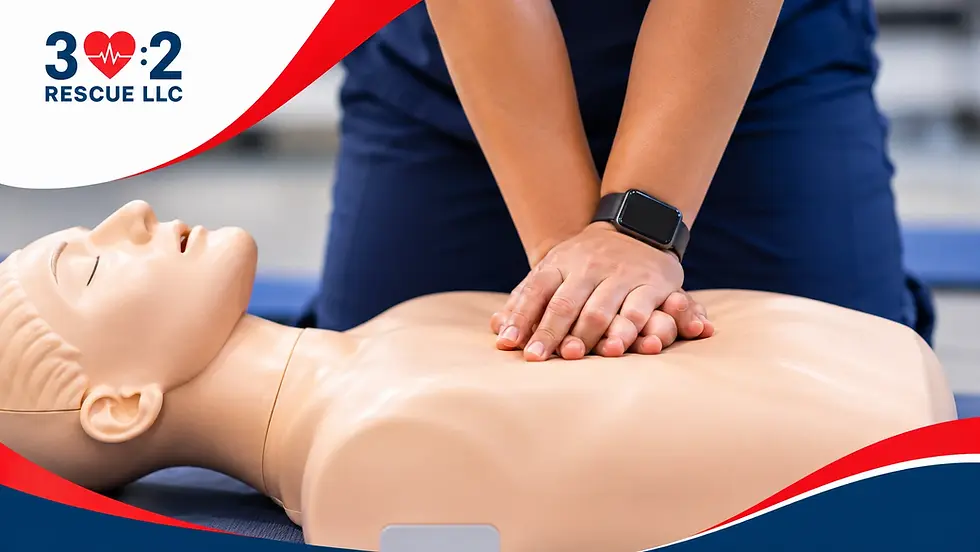
Push in the center of the chest, on the lower half of the breastbone.
Compress at a rate of 100 to 120 per minute, which is roughly two compressions per second.
Let the chest fully recoil between compressions.
Give each breath over about one second, enough to make the chest visibly rise.
Keep pauses for breaths as short as possible, ideally under 10 seconds.
Want the full story behind the number? Read our deeper guide to the 30:2 CPR ratio and why it is taught in Pasadena.
CPR Ratio Chart: Adult, Child and Infant
Here is the quick reference. Age groups follow AHA and ARC guidelines: infant is under 1 year, a child is 1- 7 years of age, and an individual who show signs of puberty is considered an adult (8 years and older).
Person | 1 rescuer | 2 rescuers | Rate | Approximate depth | Hand position |
Adult (puberty and older) | 30:2 | 30:2 | 100–120/min | At least 2 in (5 cm), not more than 2.4 in (6 cm) | Two hands, lower half of breastbone |
Child (1 year to puberty) | 30:2 | 15:2 | 100–120/min | About one-third of chest depth, around 2 in (5 cm) | One or two hands, based on child size |
Infant (under 1 year) | 30:2 | 15:2 | 100–120/min | About one-third of chest depth, around 1.5 in (4 cm) | Two thumbs encircling the chest, or heel of one hand |
Quick memory rule: Adults are always 30:2. Children and babies are 30:2 when you are alone and 15:2 when you have a trained partner.
Adult CPR Ratio: Always 30:2 (8 years and older)
For an adult, the ratio does not change when a second rescuer arrives. Both rescuers follow 30:2. What changes is the workload. With two people, one rescuer compresses and the other manages the airway and breaths, and you switch roles about every 2 minutes (roughly five cycles) so compression quality does not drop as the compressor tires.
What good adult compressions look like:
Depth of at least 2 inches, but not more than 2.4 inches
A steady rate of 100 to 120 per minute
Full chest recoil, with no leaning on the chest between compressions
Minimal interruptions, and an AED applied as soon as it arrives
Shallow compressions are the single most common problem we see on mannequins. If you want a deeper look at what goes wrong, read our guide to common CPR mistakes and how to avoid them.
Child CPR Ratio (1 Year to 7 years old)
A lone rescuer uses 30:2 on a child. When two trained rescuers are present, the ratio changes to 15:2: 15 compressions, then 2 breaths.
Child CPR also differs from adult CPR in a few practical ways:
Use one or two hands, depending on the child’s size and your ability to reach the target depth.
Compress about one-third the depth of the chest.
Rescue breaths matter more, because many pediatric emergencies start with a breathing problem.
The 2025 AHA and American Academy of Pediatrics guidelines also say lay rescuers should start CPR for an unresponsive child who is not breathing normally without stopping to check for a pulse. Healthcare professionals may check for a pulse for up to 10 seconds before starting compressions.
If you care for children, see how infant, child and adult CPR differ for parents.

Infant CPR Ratio (Under 1 Year)
The infant ratio matches the child ratio: 30:2 for one rescuer and 15:2 for two rescuers.
Technique is where infant CPR looks different:
The 2025 AHA and American Academy of Pediatrics guidelines no longer teach the two-finger compression technique for infants. Use the two-thumb encircling hands technique, or the heel of one hand.
Compress about 1.5 inches deep, about one-third the depth of the chest.
For breaths, cover the infant’s mouth and nose, and give gentle breaths just large enough to make the chest rise.
Parents, grandparents and babysitters often tell us infant CPR is the skill they fear most. It is also the one that gets easier the moment you practice on a mannequin. Our local guide to infant CPR classes in Pasadena explains what to expect.
Why Does the Ratio Change With Two Rescuers?
In adults, cardiac arrest usually starts with a heart rhythm problem, so uninterrupted compressions carry most of the benefit. In children and infants, cardiac arrest more often follows a breathing problem. More frequent breaths per compression make sense, and two rescuers can deliver them efficiently: one compresses while the other holds the airway open and ventilates.
It is worth knowing that the AHA describes the best pediatric ratio as uncertain. Large studies of children in cardiac arrest outside the hospital showed better outcomes with ratios of either 15:2 or 30:2 than with compression-only CPR. You can read the recommendation in the AHA 2025 Pediatric Basic Life Support guidelines. The practical takeaway for rescuers is simple: use the ratio you were taught, and do not stop.
Hands-Only CPR vs. Compressions and Breaths
If you see an adult collapse and you have no CPR training, call 911 and push hard and fast in the center of the chest. This is hands-only CPR, and it is far better than doing nothing.
If you are trained and willing, compressions with breaths is the standard. It matters most for children and infants, where a breathing problem is more likely to be the cause. The 2025 pediatric guidance encourages lay rescuers to give breaths if they are able and willing.
Not sure which approach fits your situation? Our comparison of hands-only CPR vs. traditional CPR walks through both.
What Changes With an AED or an Advanced Airway?
With an AED: Turn it on, attach the pads, and follow the voice prompts. Do not stop CPR until the device tells you to, and resume compressions right after a shock. Our step-by-step guide to using an AED covers pad placement and safety.
With an advanced airway (healthcare providers): Once an advanced airway such as an endotracheal tube is in place, the 30:2 and 15:2 cycles stop. Compressions become continuous at 100 to 120 per minute. In adults, a breath is given about every 6 seconds. In children and infants, the AHA recommends 20 to 30 breaths per minute. These are healthcare provider skills taught in BLS courses.
6 Common CPR Ratio Mistakes
Using 15:2 on an adult. Adults are 30:2, even with two rescuers.
Using 30:2 with two trained rescuers on a child or infant. The two-rescuer ratio is 15:2.
Pausing too long for breaths. Long interruptions reduce blood flow. Keep each pause short.
Compressing too shallow or too slowly. Aim for the right depth and 100 to 120 compressions per minute.
Breathing too hard or too fast. Each breath should last about one second and make the chest rise. Excessive ventilation can do harm.
Not switching compressors. Swap roles about every 2 minutes, or sooner if the compressor is tiring.
If you make a mistake in a real emergency, keep going. Imperfect CPR is better than no CPR.
Learn the Right Ratios Hands-On in Pasadena
Reading the numbers is the easy part. Doing 30 good compressions and two clean breaths takes practice. At 30:2 Rescue LLC, students practice adult, child and infant skills on professional mannequins, with AED trainers, guided by instructors with real emergency response backgrounds. We are an authorized training center for both the American Heart Association and the American Red Cross, and your digital certification is delivered within 10 minutes of completing the course.
We offer evening and weekend sessions, and we can bring training to your workplace, school or organization on request. Groups of six or more qualify for a discount. Browse the full list on our CPR and BLS classes in Pasadena page.
If you are… | Consider this class |
A parent, teacher, coach or office team member | ARC Adult/Pediatric First Aid/CPR/AED (in person) or blended training AHA Adult/ Pediatric First Aid/CPR/AED ( In Person) or blended training (Total HeartSaver) |
A childcare provider needing pediatric training | EMSA (Emergency Medical Service Authority) Training Please note: Childcare provides should refer to state and county regulations |
First time parent/grandparent or babysitter | Pediatric First Aid/CPR/AED ( In Person) training |
A nurse, EMT, dental or other healthcare professional | AHA BLS Provider (Initial) in person or blended training ARC BLS Provider blended training |
A healthcare provider renewing a current card | AHA BLS Provider (Initial) in person or blended training ARC BLS Provider blended training |
Not sure which course your job or license requires? Our guide to AHA BLS vs. Heartsaver can help, or contact us and we will point you to the right class.
Please Note: While the information provided in the chart above reflects common CPR certification requirements, 30:2 Rescue LLC strongly encourages all participants to verify their specific CPR training and certification requirements with their employer or educational institution before registering. This helps ensure you select and enroll in the appropriate course that meets your individual requirements.

Frequently Asked Questions
What is the CPR ratio for adults with two rescuers?
The ratio is 30 compressions to 2 breaths (30:2), the same as with one rescuer. The second rescuer helps by managing the airway and breaths and by switching compression duty about every 2 minutes.
What is the CPR ratio for a child with two rescuers?
When two trained rescuers perform CPR on a child without an advanced airway, use 15 compressions to 2 breaths (15:2). A single rescuer uses 30:2.
Is the infant CPR ratio different from the child ratio?
No. Infants and children share the same ratios: 30:2 for one rescuer and 15:2 for two rescuers. The technique and depth are what differ, with the 2025 guidelines recommending two thumbs encircling the chest or the heel of one hand for infants.
Do I keep doing 30:2 when an AED arrives?
Yes. Keep doing CPR while the AED is turned on and the pads are attached. Then follow the device’s prompts, stop when it says to analyze, and resume compressions immediately after a shock or a no-shock message.
Are the ratios the same in American Heart Association and American Red Cross classes?
The core ratios covered here are taught the same way in the courses we offer. Some terminology and skills sheets differ slightly between organizations, so your instructor will cover the exact version for your course.
Can I learn CPR entirely online?
No. CPR is a hands-on skill, so our certification courses include in-person practice. Blended courses combine an online portion with an in-person skills session, as explained on our blended course requirement page.
How long is a CPR certification valid, and when should I renew?
Certification is valid for two years. Read our guide on CPR renewal vs. recertification in California to plan ahead.
Ready to Practice the Ratios?
The best time to learn 30:2 is before you ever need it. Book a class with 30:2 Rescue LLC, the Pasadena training center that helps you learn the rhythm, practice the skills and earn a certification employers accept. Visit our Pasadena CPR classes page to choose a class, or call us at 213.293.7408.
This article is for educational purposes and is not a substitute for hands-on training. In an emergency, call 911.


Comments